
Flip & Floss:
Case Study
Teaching Kids Financial Responsibility Through Gamification
Role: UX/UI Designer
Tools: Figma, Illustrator, Userberry
Duration: 12 weeks
The challenge
Many kids struggle to grasp financial concepts, making it difficult for them to develop smart money habits early on. Traditional finance education feels dull and abstract, leading to a lack of engagement. Parents, on the other hand, want their children to learn responsibility, understand the value of money, and build healthy saving and spending habits—but they often struggle to find tools that make financial learning both effective and enjoyable.
How do we make financial literacy as captivating and rewarding for kids as their favourite game?
Objectives
Make financial education engaging by integrating gamification elements like challenges and rewards.
Help kids connect earning to spending by incorporating chores and goal-based savings.
Provide a simple, kid-friendly interface that makes financial concepts easy to understand.
Empower kids to make informed spending decisions by visually tracking progress and comparing prices.
Support parents in reinforcing financial responsibility without micromanaging their child’s experience.
Research Phase
We began by understanding how kids learn financial habits and what motivates them.
User Research
To gain insights, we conducted:
Parent Interviews – To understand how they currently teach their kids about money.
Survey with Kids (via Parents) – To identify their understanding of saving/spending.
Secondary Research – Exploring competition available on the market.
Usability Testing with Kids using Userberry – Remote user testing allowed us to observe how kids interacted with the app in a natural setting.
Key Findings:
Kids learn best through hands-on experiences rather than abstract lessons.
Gamification increases engagement and retention—kids respond well to rewards and challenges.
Parents want an app that reinforces good habits without being too complex.
Existing finance apps feel too 'adult'—kids need a more approachable design.
Competitive Analysis
We analyzed competitor apps to identify gaps. Many apps focused on parental control rather than kid engagement, reinforcing our decision to prioritize interactive, self-driven learning experiences.
Ideation & Strategy
With research insights in mind, we brainstormed ways to make learning about money exciting and interactive.
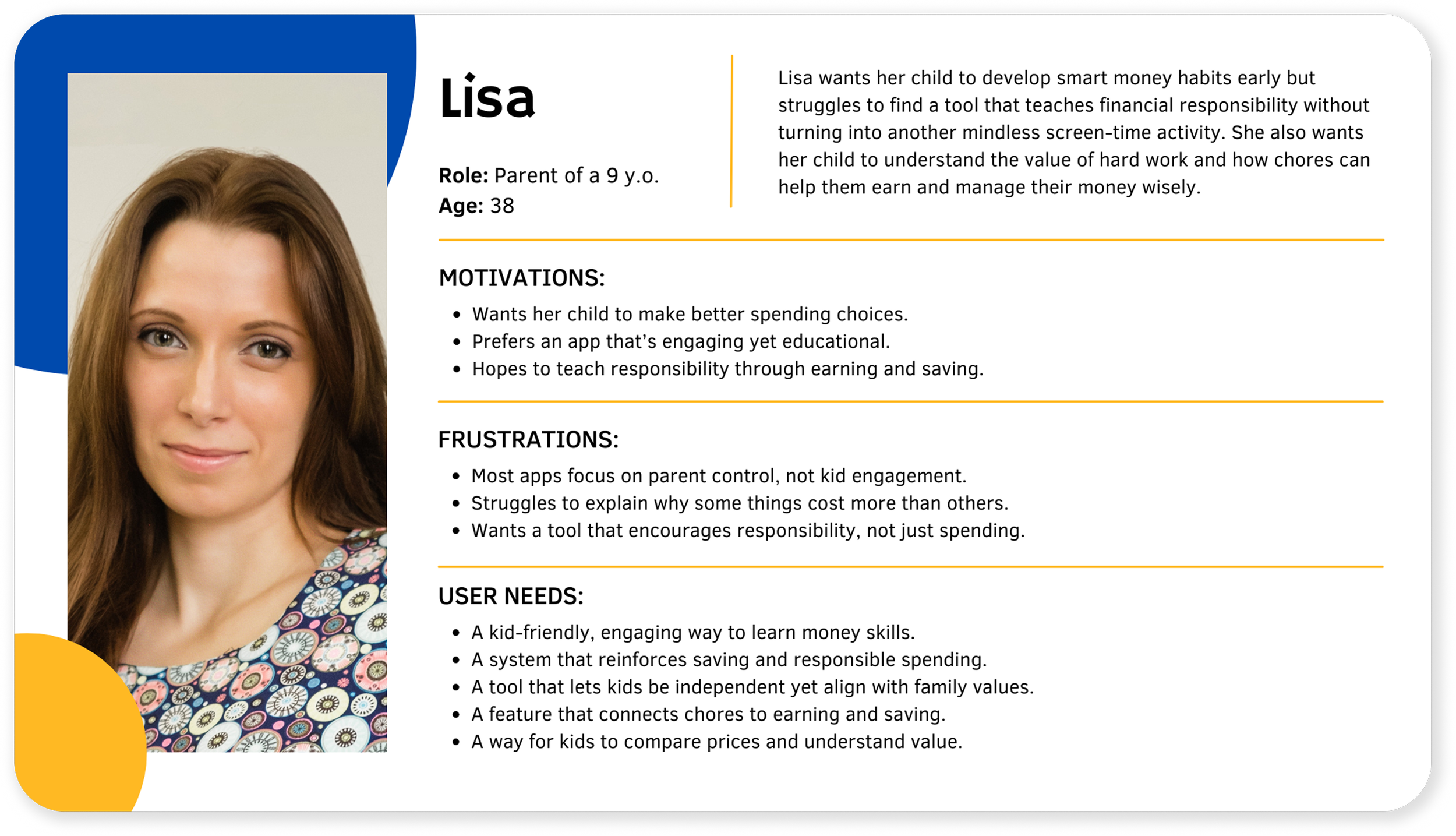
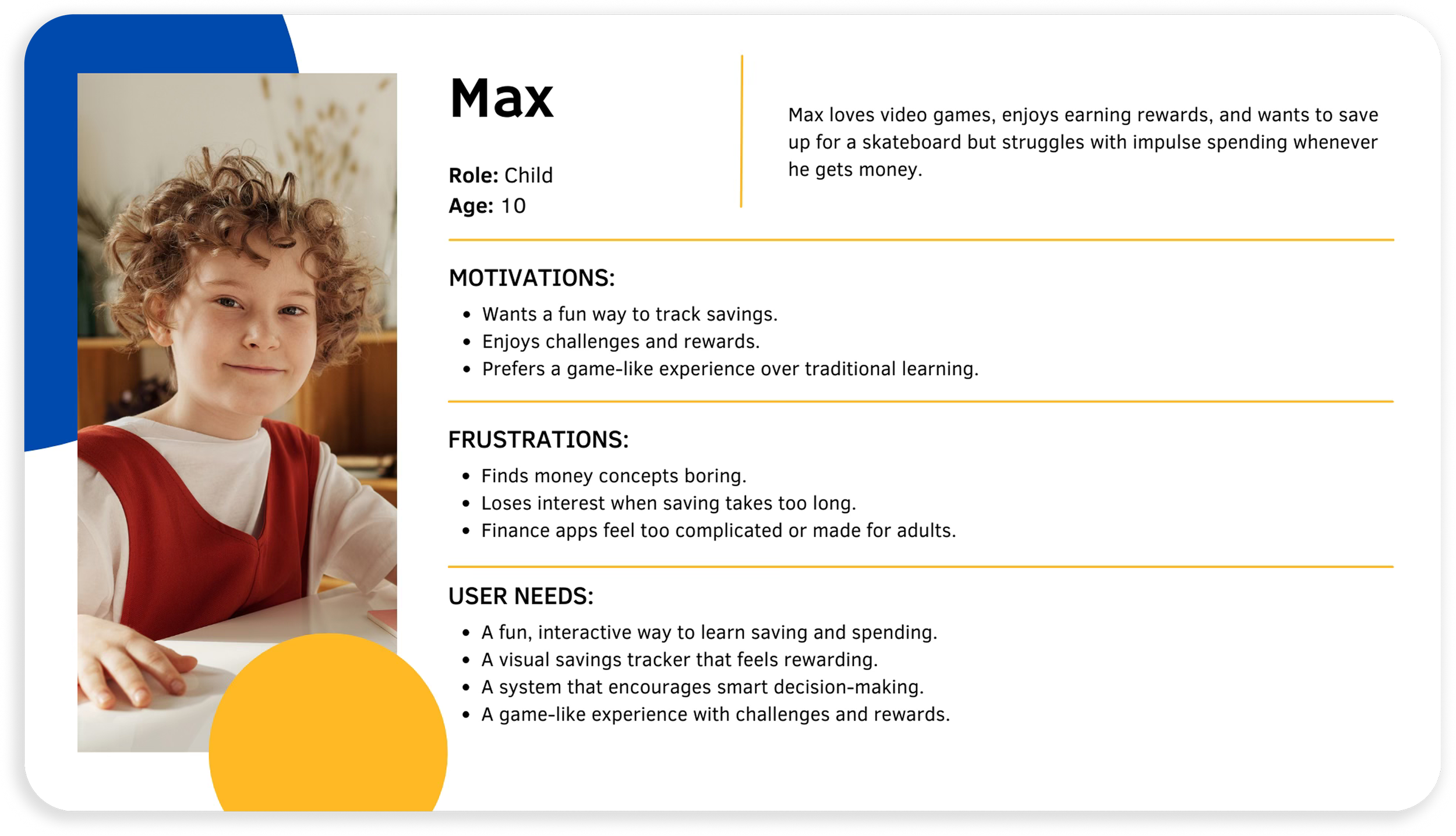
Personas & User Needs
Core Features
Gamified Challenges – Kids complete money-related tasks (e.g., setting a savings goal, tracking allowance) to earn in-game rewards.
Visual Progress & Rewards – Kids can customize a virtual space using rewards earned through saving goals.
Engaging, Kid-Friendly Interface – Designed with playful colours, simple navigation, and interactive elements.
Design Phase
With a better understanding of our core audience, their technology habits, and what keeps them engaged with
an app, we translated our ideas into sketches, wireframes, and a final high-fidelity prototype.
Based on the research, the Flip & Floss app would showcase the following features:
Custom Avatars & Playful UI
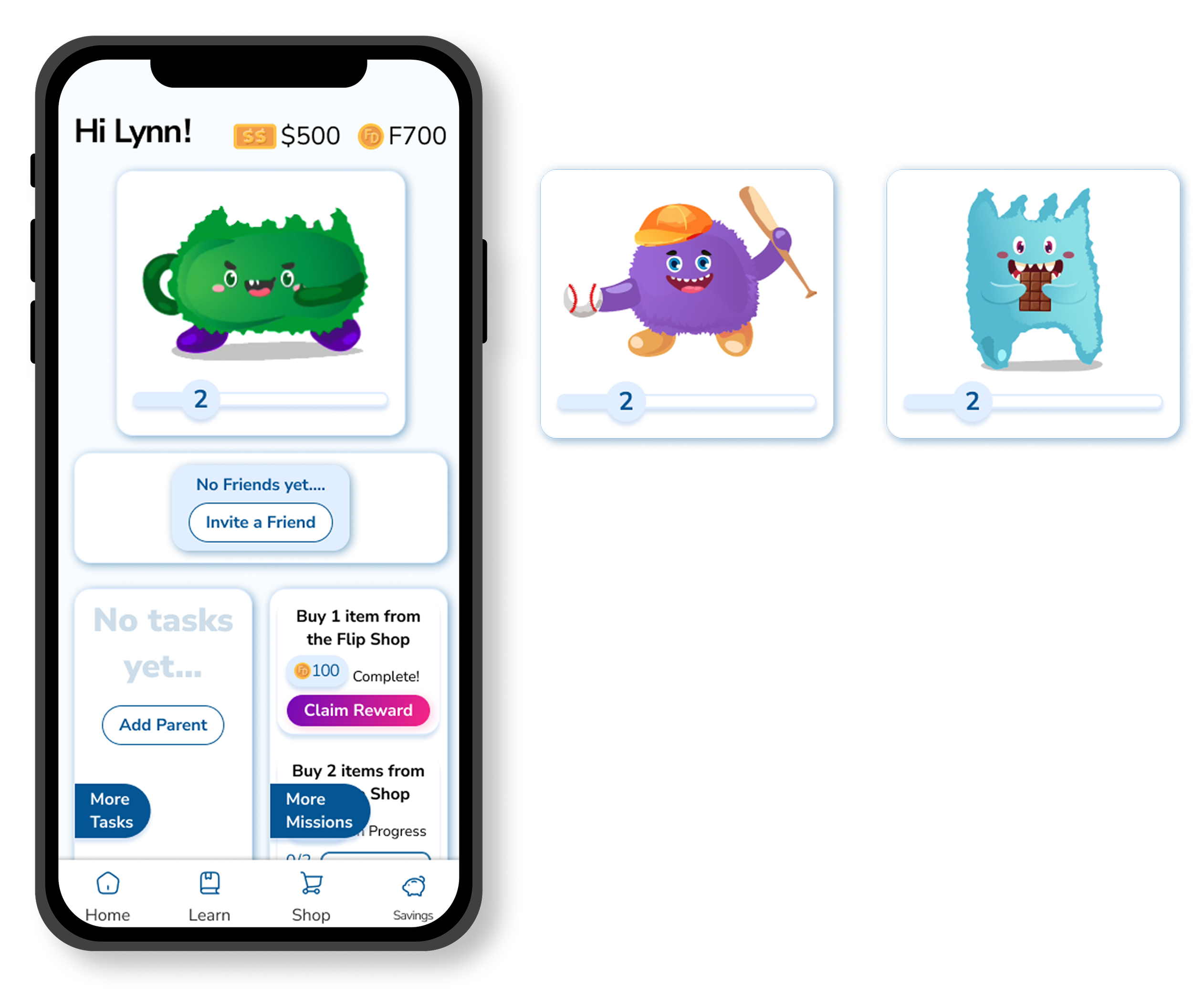
To make the app feel more personal and engaging, we introduced custom avatars—brightly coloured, cute monster characters that kids can choose and customize. Players can earn Flip Coins by completing chores and use them to buy decorative items like shoes, accessories, or fun outfits for their avatar.
This feature does more than just enhance engagement—it teaches resource management. Kids must decide whether to spend their earnings on virtual items or save up for real-life purchases, reinforcing the concept of money allocation and financial decision-making in a way that feels natural and fun.
Tangible Progress
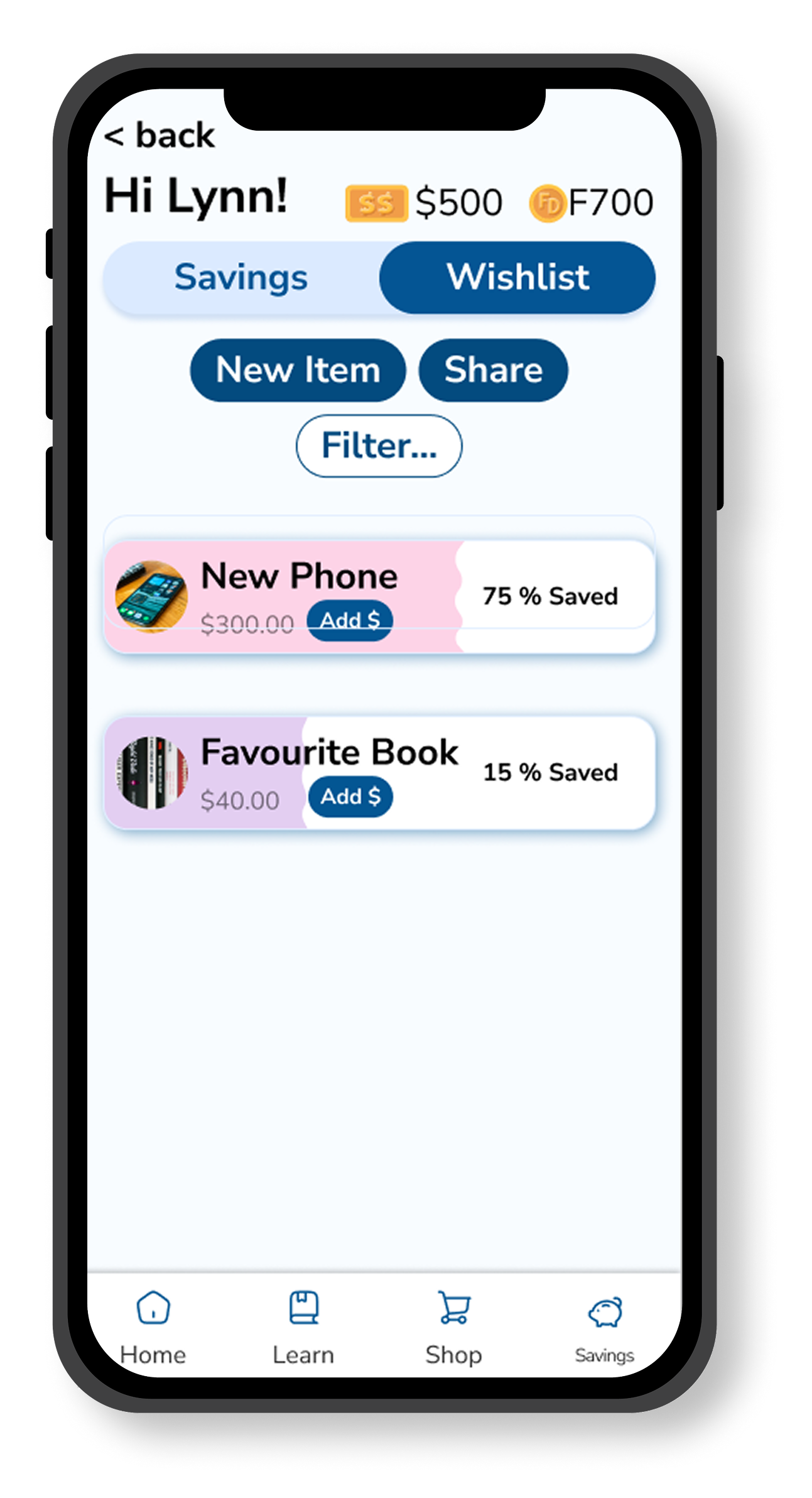
Our findings revealed that children are more motivated when they see instant feedback and tangible progress in their savings. Additionally, parents emphasized the need for a tool that teaches responsibility through real-world earning experiences, like chores, rather than just theoretical lessons.
These insights shaped our design approach: the app needed to be visually engaging, goal-oriented, and interactive, with a balance between entertainment and education.
Gamification
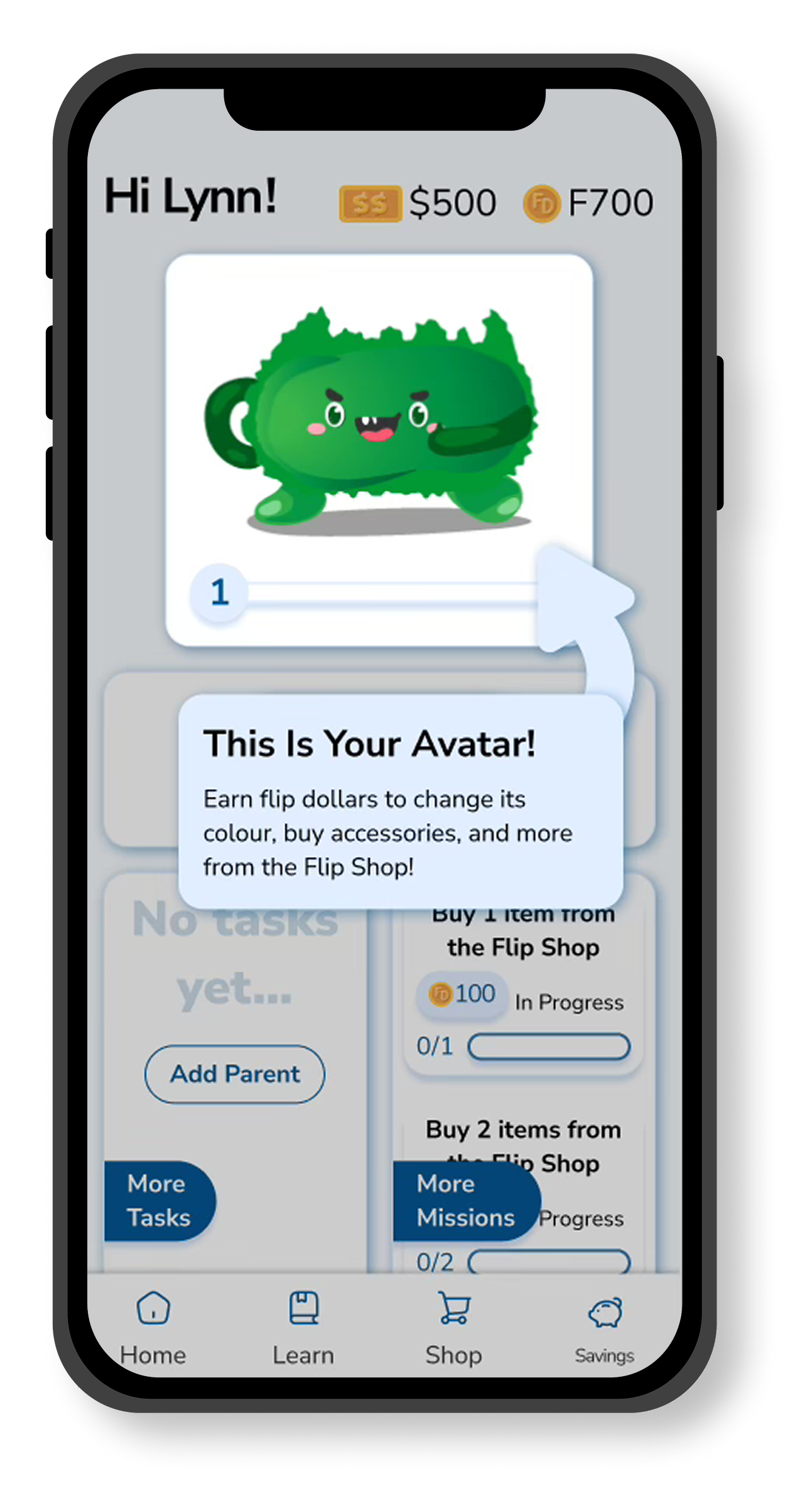
One of the biggest challenges was making financial literacy exciting for kids. Our research showed that children are drawn to reward-based systems, similar to how video games use achievements and levels to keep players engaged. To leverage this, we introduced challenges, rewards, and progress tracking to make learning about money feel like a fun and rewarding game.
For example, instead of a static savings tracker, we designed a visual savings goal system, where kids can see their progress toward purchasing an item they want. Completing financial challenges earns them in-app rewards, reinforcing positive habits while keeping them engaged. This approach turns financial learning from a chore into an interactive experience that kids want to participate in.
Wireframes & Prototypes
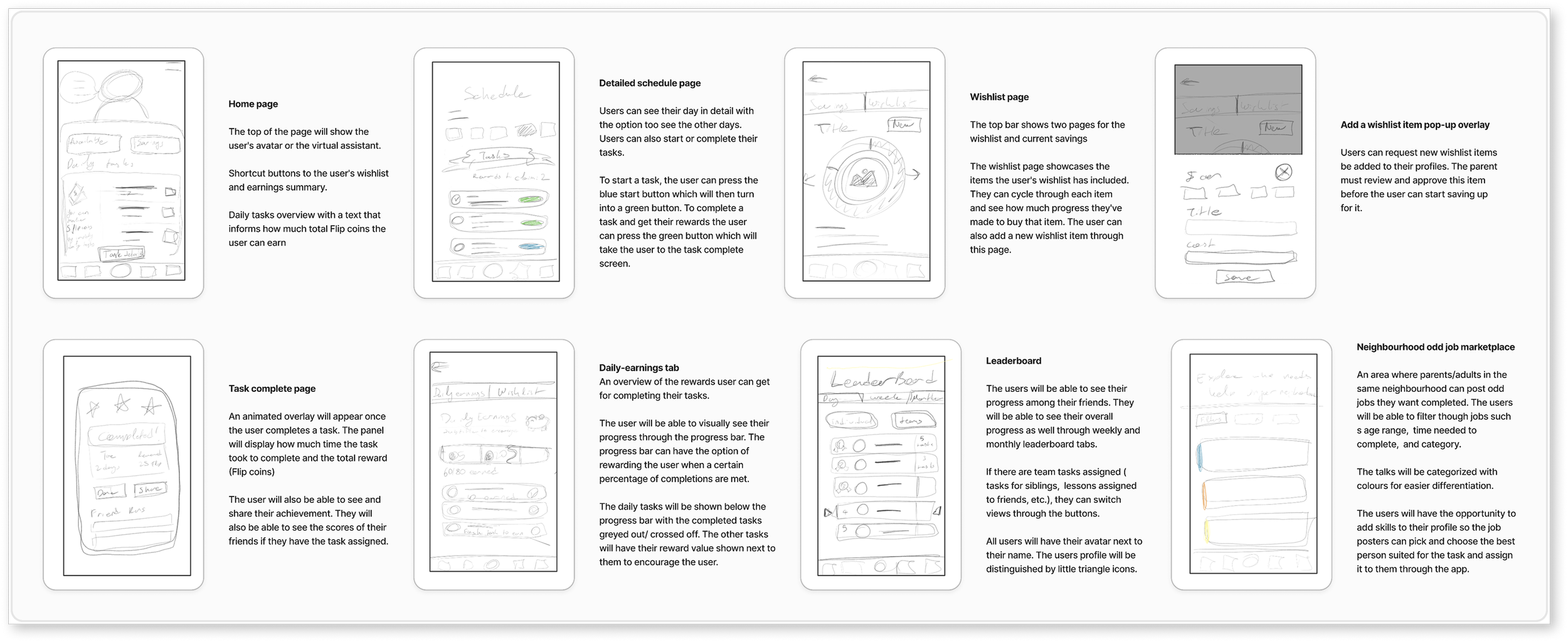
We sketched early wireframes to map out the user journey and iterated based on feedback. Below are some of the key screens:
Outcome & Learnings
Flip & Floss successfully blends fun and financial education, turning what could be a dull learning experience into something interactive and rewarding. By integrating gamification and kid-friendly design, the app helps children build healthy money habits while keeping them engaged. Through interactive challenges and visual goal tracking, kids gain a clearer understanding of savings and spending, making financial concepts more accessible and intuitive. The playful and user-friendly design ensures that learning remains enjoyable, encouraging kids to return to the app regularly and build lasting financial skills.
On a personal level, this project was a valuable learning experience in designing for younger users. It reinforced the importance of adapting UI to meet the cognitive and behavioural needs of children, ensuring that interactions are simple, engaging, and easy to navigate. Exploring gamification strategies also provided insights into how rewards and challenges can drive motivation, making complex topics more digestible. Additionally, collaborating with a team throughout the ideation and iteration process strengthened my ability to refine ideas through feedback and problem-solving, creating a product that is both educational and enjoyable for its young audience.